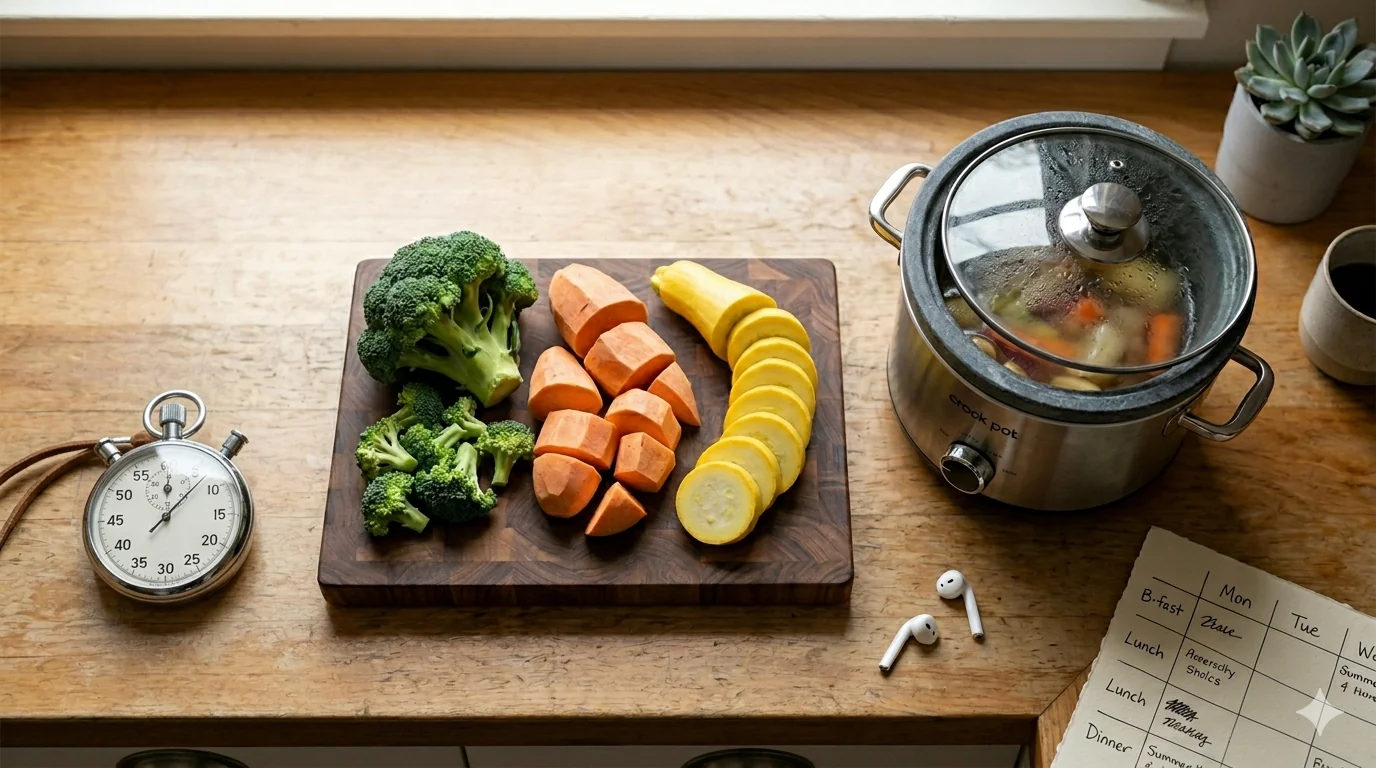
Meal Planning Framework
Published on 3/17/2026
•7 min read
•A meal planning framework is a repeatable weekly system for deciding what to cook, when to shop, and how to prep food in advance — so that weeknight dinners take fifteen minutes instead of an hour. The goal is not to find new recipes every week, but to build a short, reliable menu and a weekly rhythm that shifts cooking work away from busy evenings. This is the system I built after needing to cook entirely from scratch without spending every spare moment in the kitchen.
About a year after our son was born, I was diagnosed with Ulcerative Colitis. In an effort to help manage it (and generally eat better), I started cutting out most processed foods and cooking nearly everything from scratch. That would have been fine on its own — but I was also a new parent, sleep-deprived, and already feeling like I was spending every spare moment in the kitchen. Something had to give.
I didn't want to go back to processed food. And I couldn't cook every single day. So I started building a system.
The Core Idea
The goal isn't to find the perfect recipe. It's to make cooking feel less relentless. That means shifting work away from the high-pressure evening hours and spreading it across the week in manageable chunks.
The targets I set for myself:
- Clean and cut produce only 3x per week
- Actually cook only 4 days per week
- Shop only 2x per week
- Have dinner on the table in 10–15 minutes most nights
- Keep everything made from whole foods, mostly from scratch
The key to making those last two co-exist is cooking asynchronously — doing the work ahead of time so that "making dinner" is mostly just reheating and assembling. More on the specific methods below.
The Weekly Rhythm
I shop twice a week, usually Monday or Tuesday and again Thursday or Friday. The spread matters: it keeps sensitive items like meat and dairy fresh without requiring daily trips.
On shopping days, I try to start cooking the same afternoon. My kids still nap, which gives me a reliable one-to-two hour window to get things started. If I can't cook that afternoon, the next morning is my fallback — I'll carve out a bigger chunk of time to do most of the week's prep.
Dinners are almost always microwave-ready. Either something has been in the crock pot all day, a protein came out of the sous vide, or there's a batch of soup in the fridge waiting to be heated. The kids are playing, dinner comes together in under 15 minutes, and we get the evening back.
Breakfasts during the week are fast by design. I make baked oatmeal in batches and freeze it in individual portions. In the morning I pop it in the microwave for the whole family and add some fruit or a smoothie. Done.
Lunches get a little more flexibility. On slower mornings, the kids can help put together a salad — which is actually one of the better ways to get them engaged with food. On preschool days, we do sandwiches: fast, low-mess, minimal cleanup.
A Limited Menu Is a Feature, Not a Bug
One of the biggest shifts in my thinking was accepting that I don't need variety for its own sake. A shorter menu of meals I know well is faster to shop for, easier to batch, and less mentally taxing than trying to cook something new every week.
I try to keep the ingredients versatile. I want to minimize scraps too, so being able to use that large bag of carrots for more than one dish is a huge win.
I organize everything into four categories:
Mix & Match: Protein + Veggie + Starch
The most flexible category. Pick one from each column and you have a meal. Proteins are often done sous vide ahead of time; everything else roasts while I'm doing something else.
Proteins: Pork tenderloin, chicken breast, steak
Vegetables: Italian sheet pan, broccoli, cauliflower steaks, Brussels sprouts, squash, asparagus
Starches: Brown rice, quinoa, sweet potatoes, potatoes
Soups & Stews
This is where the crock pot earns its keep. I'll start one in the morning and it's ready by dinner. Almost all of these freeze well, so I often make a double batch.
- Beef and barley (over rice)
- Annie's tortilla soup (over rice)
- Italian pork and white bean
- Provençal chicken
- Homestyle chicken
- Paranto white bean soup
- Farro butternut squash
- Pumpkin turkey chili
- Italian lentil soup
- Smoky chicken and lentil soup
Big Pot
One pan or pot, lots of servings. These are workhorses.
- Pork and pickled green beans (over rice)
- Chicken stir-fry (over rice)
- Spanish rice with turkey
- Chicken cacciatore
- Meatballs and spaghetti squash
- Shakshuka with poached eggs over rice
- Pan roasted chicken and vegetables
Sandwiches
The "crunch time" category. Fast to assemble, easy to adapt for the kids.
- Protein with hummus on tortillas (plus a veg)
- Mexican quinoa with sautéed veg and greens
Asynchronous Cooking
The secret ingredient in all of this is cooking methods that don't require me to be present. My two favorites:
Sous vide for proteins. I can seal up a pork tenderloin or a few chicken breasts in the morning and they'll be perfectly cooked hours later with zero monitoring. When dinner time comes, a quick sear is optional but the protein is already done.
Crock pot for soups, stews, and braises. Load it up, walk away. It's also one of the best ways to turn cheaper, tougher cuts of meat into something really good.
I also use the microwave more than people might expect — not just for reheating, but for cooking pasta and softening vegetables faster during prep. It cuts down on pots and on active stove time.
Check out my post on asynchronous cooking for more on this topic.
Meal Planning Methods Compared
| Method | Weekly Active Time | Flexibility | Best For | Upfront Setup | |---|---|---|---|---| | Sunday batch cook | 3–4 hours once | Low — committed to what you made | Single people, simple diets | Medium | | Async cooking (daily) | 15–20 min/day | High — choose each day | Families with varied preferences | Low | | Meal kit service | 30–45 min/night | Medium — choose from limited options | People who want variety without planning | None | | Hybrid (prep + async) | 1–2 hours once + 10 min/night | High | Families managing dietary needs | Medium | | No-plan reactive | 45–60 min/night | High | Not recommended with young children | None |
Planning the Week
The practical starting point is simple: look at your week, identify the days that are going to be chaotic, and make sure those are microwave nights. Then fill in backward from there — what needs to be prepped the day before? What can the crock pot handle?
Pick your shopping days first, then your prep windows, then your cooking days. Everything else falls into place around those anchors.
It took me a few months of iteration to settle into a version of this. Now I also use my AI cooking consultant to help me with meal planning.
Frequently Asked Questions
- What is a meal planning framework?
- A meal planning framework is a repeatable system for deciding what to cook, when to shop, and how to prep food in advance so that weeknight dinners require minimal effort. Rather than deciding what to cook each day, a framework gives you a limited menu of reliable meals organized into categories, a fixed shopping cadence, and designated prep windows. The goal is to shift work away from busy evening hours and spread it across the week in manageable chunks.
- How do I build a weekly meal planning system?
- Start by choosing two fixed shopping days per week spaced a few days apart — this keeps perishables fresh without daily trips. Identify two or three prep windows when you can cook in advance, ideally the same day as a shopping trip. Build a short menu of ten to fifteen reliable meals organized by type — proteins with sides, soups and stews, one-pan dishes — and rotate through them. The key is a limited, well-known menu rather than cooking something new every week.
- What is the best meal planning method for busy parents?
- For busy parents, the most effective meal planning method combines a fixed weekly rhythm with asynchronous cooking techniques. Shop on set days, use a slow cooker or sous vide for hands-off cooking during nap time or work hours, and keep a short menu of meals you know well. This approach means dinner is usually a matter of reheating or assembling rather than cooking from scratch — reducing active kitchen time to ten to fifteen minutes most nights.
- How does meal planning reduce weeknight stress?
- Meal planning reduces weeknight stress by moving decisions and prep work out of the high-pressure evening hours. When proteins are already cooked and soups are already made, dinner becomes an assembly task rather than a cooking task. Knowing in advance what you are making eliminates decision fatigue at the end of the day and prevents the default of ordering takeout because nothing was ready.
- Should I batch cook or use asynchronous cooking for meal prep?
- Both approaches work, and they complement each other well. Batch cooking — making large quantities once a week — works best for soups, stews, and grains that store well and reheat easily. Asynchronous cooking — using slow cookers, sous vide, or the oven while you do other things — works best for proteins and dishes that benefit from long, low-heat methods. Using both together means you have a stocked fridge and minimal active cooking time throughout the week.